Debate 12/5/20

My debate team joined a new league this year, in order to attend more tournaments even during the pandemic. Our first tournament this year would be the tournament on December 5th, in the new league, New York Debate League (NYDL, also being my first tournament as a 8th grader. The topics for this tournament were

  1. There should be no required subjects in high school.
  2. Museums and galleries should display art anonymously
  3. The two-party system is bad for American democracy

There were four rounds for the debate, so we debated one of the topics: ‘There should be no required subjects in high school’ 2 times, once on pro and another on con.

My team lost the first round, but I tried to keep positive, after all, there were 3 more rounds. However, after losing the very next round, I began to lose hope. But I knew that I couldn’t just feel bad, instead I just needed to work hard for the next two remaining rounds. After that, we actually won the next two rounds, and ended the tournament 2-2

2020 chinese american museum dc. art

The prompt for this competition was “our time” I interpreted this as time passing in 2020. I’m pretty sure for everyone 2020 has not been the best year; starting from the pandemic.

In this watercolor piece i tried to represent isolation and a seemingly stopped time with the ice cubes. The first person is an essential medical worker, working on the frontlines. I wanted to show my thankfulness for frontline workers and other essential workers especially now! The second person is sitting in an empty metro, representing how empty all these once bustling places are now. Metros, town squares, downtowns, are now all filled with an unfamiliar sense of emptiness, loneliness, almost like a scene from a dystopian novel. The third person show the effect the pandemic has on mental health. Without being able to interact with our love ones or being able to see them in person, we can feel very lonely. Many times this can make us lose hope and lose motivation to work, or do anything, hence the girl sleeping at work.

The fire outside the ice shows both the irony of global warming and the state of 2020 itself. While the pandemic has made us feel as if time has come to a stop, as if we were in an ice age, simultaneously, global warming is just becoming a bigger and bigger issue. At the same time, 2020 in itself just feels like chaos, time feeling both slow and fast for some, represented by the flames engulfing everything else.

The clocks in the background represent different countries and how different countries have been handling the pandemic differently, either drawing out the pandemic or putting slowing it down which is why their times are all different.

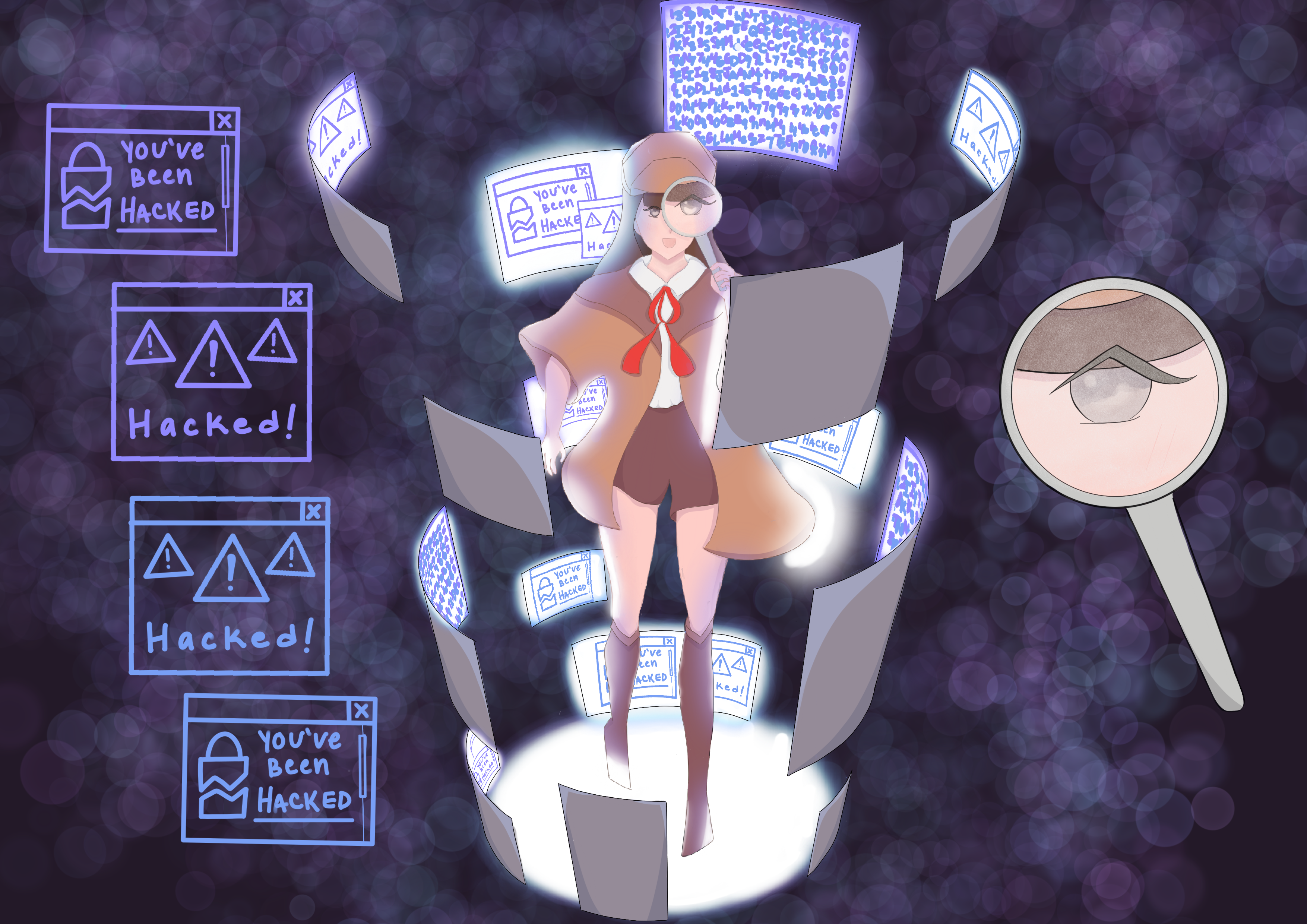
Detective art competition

A cyber detective; a detective that solves crimes digitally

In July of 2020 I entered an art competition that featured students’ drawings from all over the world. The topic of the competition was based around the future career that we dreamed of having in the year of 2040.

At first, I couldn’t decide what exactly to be. After a while though, I decided that I would put a twist on something that I already wanted to be. I’ve always been interested in true crime and I love a good mystery! Now with everything becoming more digitalized I decided I would want to experiment with a digital detective.

My piece is also featured here: https://swissnexinnewyork.org/workingtomorrow-visions-of-the-future/

This is my piece on featured on the website, My description reads:


“In the year of 2040, I will be a cyberdetective – a detective that fights all different kinds of online crimes. More and more crimes are committed online, as our society becomes increasingly digitized. Therefore, I want to be able to fight crime-online!”

The ABCs Of Law School

Basic Vocabulary

  • Plaintiff: The person that brings the case to the court (The person that accuses)
  • Defendant: The person that is being accused

Chapter 1: Admissions + Applications 

  • LSAT – Law School Admissions Test
    • 5 parts- 1. Logic Games 2. Reading Comprehension 3.Arguments 4. Experimental 5. Short Essay 
    • CAS- service that assembles a report of transcript, LSAT…
  • GPA + Recommendations

Chapter 2: Choosing a School

  • ABA Accredited School 
    • Can Practice law in any state
    • What is studied
      • Common law- the history of case law in England + America
      • Case law- rules of law found in court decism 
      • Statutory law- laws enacted by state legislatures by Congress
  • State Accredited
    • Only practice law in certain state 
  • Non-Accredited  
    •  Not really reliable
  • Choosing law school on ratings
    • All law schools have the same skills and courses in the first year
      • After that many electives
  • Law Professors
    • Research
      • Publications in law reviews
      • Edit case books
      • Write books
    • Accessibility needs to be considered

Chapter 3: First year Overview

  • Fundamental First Year Classes
    • Torts
    • Legal Research + Writing
    • Contracts
    • Civil Procedure
    • Criminal Law
    • Real Property
    • Constitutional Law
  • These are tested on bar examination 
  • Current Trends in Teaching law
    • Letter Grades
    • More and more material to teach
      • Society expands 

Chapter 4: Torts

  • Torts 
    • Tort is an ‘injury or wrong’
    • Under Civil law, means may not necessarily be illegal but causes harm-> can still overlap within criminal law like trespassing 
  • Teaching methods
    • Socratic Method 
      • Students already read texts
      • Discuss in class
        • Professors use class time to ask analytical questions and lead discussions on the text that was read for homework
    • IRAC Method
      • I- Issue of the law, the conflict
      • R- Rule of Law, How law applied 
      • A- Analysis, discussion of facts of case + a applicable law
      • C- Conclusion, A summary of all the facts + applied law + verdict
  • Some Vocabulary
    • Liability- responsibility for one’s conduct
    • Tortfeasor- someone that commits a torts
    • Tortious- conduct that subjects someone to liability because of a tort
  • Intentional Tort
    • Intends to cause harm/injury
    • Against Person
      • Assault, Apprehension of Immediate harmful contact
      • Battery, harmful/offensive physical contact 
      • Assault v.s. Battery: Assault only needs apprehension from victim while Battery has to have actual physical contact
    • Against property
      • Trespassing 
  • Negligent Torts
    • Failure to care to a certain degree
      • That a normal reasonable person would in the same circumstances
    • When plaintiff believes defendant has breached a ‘duty of care’
  • Strict Liability Tort
    • “Strict liability exists when a defendant is liable for committing an action, regardless of what his/her intent or mental state was when committing the action.” – Cornell Law
    • Does not have to be at fault, only needs to prove that tort has occurred and is caused by the defendant. 
    • This is applied to situations that are inherently dangerous
  • A Mnemonic learning Device (Page 190) for dealing with Torts Questions

Chapter 5: Legal Research + Writing

  • Legal Research and Writing- Teach how to find law in law library and write legal papers
  • Substantive law
    • structure/govern everyone in society 
    • Rights and responsibilities for civil law 
    • Crimes and punishments in criminal law
    • Examples: 
      • Torts
      • Contracts
      • Wills 
      • Penal codes
  • Procedural law
    • Systems that are set to make, administer and enforce substantive law. 
    • How courts hear/resolve cases + how proceedings are governed

3 Basic sources of Law

  • Codes
  • Aka Statues, known collectively as statutory law 
  • Starting point of most research 
  • State Statutes 
    • Each state has a set of codes for various aspects of life
  • Federal Statutes
    • After passed by Congress, President signs it into law, it becomes codified
      • Placed into United States code (USC) 
  • Case law
  • Derived from actual cases instead of codes/statutes
  • Trials usually begin on county courts and are available online
  • State Court Decisions
    • Reports 
      • Written decisions of a state appeals court 
    • Appellate court/appeals court   
      • Can review cases from a lower court 
    • Review 
      • A review of the decision from a lower court can be requested through a appeals court
    • Appellant/Petitioner 
      • The person that appeals the lower court decision  
    • Appellee/Respondent 
      • The person that is against repealing lower court decision
    •  Court decision’s contained the court’s opinion (reason for decision), laws that applied to case, and judgement
    • Judgement 
      • Court’s decision on rights of the parties 
  • Published opinions of appellate courts 
    • Majority opinion
      •  When all that review case disagree with court’s ruling 
    •  Concurring opinion 
      • judges/justices want to emphasize a point 
    • Dissenting opinion 
      • Written by judge/justice that disagrees with majority opinion 
  • Binding v.s. Persuasive Authority 
    • Binding authority
      • Lower courts have to follow rulings of higher courts in jurisdiction
    • Persuasive authority
      • Not required to follow decisions made by higher courts in other jurisdictions 
  • Administrative law
  •  The decisions of administrative agencies
  • Administrative agencies are made when a branch of government give some of their authority to group of people that are deemed experts in a particular field
    • Example: DMV
  • Branches of US government
    • Legislative: Create law 
    • Executive: Enforces law
    • Judicial:interprets law
  • Shepardizing
    • Means to verify that the information being cited is still ‘good law’ meaning it has not yet been overruled, modified, or criticized heavily.  
  • Citations
    • Shorthand notation to identify and locate a source of law
    • Where they are used
      • Briefs, legal documents presented in court to prove why a party should win
      • Legal memorandums, informal documents to aid parties involved in legal matters to remember points of law/facts
      • Law review footnotes, a student run journal that publishes articles by law professors,..- other legal professionals 
    • The Bluebook is the basics of citation forms in legal matters 

Chapter 6: Contract Law

  • Contract, a legally enforceable promise 
  • Contract law shows to what extent promises that are legally binding can go
  • Contract Vocabulary
    • Assignee: the person that transfers (property, contract, other rights) from contract to another person 
    • Executor: Person to carry out terms of will 
    • Decedent: deceased person that writes the will
    • Consideration 
      • A benefit that is agreed to by parties, the reason why the contract is made
      • A necessary element for a valid contract
      • Is the inducement to a contract 
      • May also be referred to as quid pro quo 
        • Latin term :‘This for that’ :bargain exchange
    • Inducement: a promise that allows for parties to enter into agreement 
  • Briefing a case
    • Similar to the IRAC approach in analyzing case law
    • A student brief, a short summary + analysis of the case
      • Sort out the parties
      • Identify issues
      • What was decided 
      • Analyze reasoning behind the decision
  • Different ways of briefing cases
    • The name of case
    • Nature of case
      • The form of action 
        • (Negligence, breach of contract, assault)
      • Type of proceeding
        • (appeal, summary judgment, demurrer)
        • Summary judgement: put early end to lawsuit 
        • Demurrer: written response to complaint filed in lawsuit which basically asking to dismiss case because there is no legal basis for lawsuit
      • Relief that is sought 
        • (criminal sanctions, monetary damages (material compensation))
      • Example:”Appeal of a burglary conviction”
    • Facts of case
      • Brief summary of all facts
    • The issue
      • The rule of law put in form of ‘yes or no’ question
    • The rule of law/legal rule 
      • The general principle  that the court was applying to the case 
    • Analysis 
      • A summary of the events that happened 
    • Holding/conclusion of case
      • Discussion of rule of a case + Court’s rationale 
      • Rationale: The reasoning behind the court’s decision   
  • Why cases are in law books
    • To show the majority rule 
    • To show the minority/dissenting opinion
      • This contains information called dicta
    • Historical significance
    • Decided wrong 
  • Sample case brief 
  • Elements to create a valid contract
    • List
      • Offer
      • Acceptance
      • Consideration 
        • Money
        • Promise to do/not do something 
      • Mutuality 
        • Carry out considerations
      • Certainty of terms
    • Offer
      • Written document
      • Orally 
      • Conduct of parties
    • Acceptance
      • Must be be accepted to form contract
      • Mutual assent
        • Both offers and acceptances must be explicit in a contract. The statement “I might sell you my guitar for $400” would be considered an intent to negotiate rather than an actual offer. “Sure, I’ll give you $300 for it” or “Yes, if you include the case and some strings” would not be an acceptance because the terms “accepted” are not the terms originally offered; such a statement would be deemed a counter-offer.
        • Applied words
        • Conduct of parties
          • Be in agreement based on actions even if the person didn’t officially sign the contract 
    • Consideration 
      • Inducement into contract
      • The incentive/ the bargain 
    • Mutuality 
      • Both parties have to be responsible to perform agreement
        • If this is not the case, no one is legally responsible 
    • Certainty 
      • The terms must be sufficiently definite 
  • Defenses against ‘Breach of contract’
    • Legality
      • If the contract is illegal + Both parties have equal fault 
    • Statute of frauds 
      • A statute that states that certain contracts had to written and signed by the parties
    • Capacity
      • The state of the defendant while making the contract was compromised (Drunk, insane)
    • Unconscionability 
      • Extreme unfairness in the ‘consideration’
    • Mistake
    • Fraud
    • Undue influence
      • When a party convinces another with their relationship
        • When one has more authority 
    • Duress
      • Wrongful pressure put on a party in the contract to agree to the contract
  • Compensations for ‘Breach of contract’ 
    • Damages
      • Compensates for resulting loss the nonbreaching party incurred because of the breach in contract
    • Restitution
      • Requires that the defendant return/forfeit the benefit that they unjustly received as a result of the contract
    • Specific performance
      • Breaching party has to carry out a specific order by court
        • Example: the duties in the contract 
  • Uniform Commercial Code (UCC)
    •  Common law and UCC presides over contract law
    • Governed by common law 
      • Real estate
      • Services
      • insurance
      • intangible assets
      •  employment 
    • Governed by UCC
      • Tangible objects
      • goods 

Chapter 7: Civil Procedure

Chapter 8: Criminal Law

  • There are 2 types of criminal law in the U.S.
    • Substantive criminal law
      • Defines what is criminal 
      • Gives the punishment that should be enforced as a result
    • Procedural criminal law, procedures to investigate and prosecute criminal behavior
  • actus reus + mens rea
    • actus reus, ‘guilty act’ commit a criminal act 
    •  mens rea, ‘guilty mind’ have intent that deserves blame
    • For something to be a crime, the person has to intend to to do something that state legislature/congress has deemed to be a wrong: has to be criminal intent
    • Concept is based on belief that only those that have acted in a way that makes them morally in the wrong should be punished 
    • Some crimes do not require mens rea 
      • Strict liability laws-> social benefits of strict rules outweigh harms of punishing someone morally innocent
      • Statutory rape laws 
      • Sale of alcohol to minors 
    • Crimes are put into categories: 
      • Felonies
      • Misdemeanors
      • Infractions (violations)
        • Minor offenses that can be covered by a fine and no jail time
  • Felonies and misdemeanors
    • Punishments 
      • Felonies can have a more severe punishment such as capital punishment, or imprisonment for >1 year 
      • Misdemeanors have less severe punishment such as fine, probation, community service, confinement < 1 year 
    • Nature
      • Felonies are the most serious type of criminal offense 
        • Homicide (murder, manslaughter), robbery, rape, grand larceny… ETC
        • Each felony has specific elements to be met for the defendant to be found guilty 
      • Misdemeanors 
        • Public intoxication, vagrancy, assault + battery… ETC
  • Category of crimes
    • Personal Crimes (injury or harming of wellbeing to another individual) 
      • Assault 
      • Battery
      • False imprisonment
      • Homicide 
      • Rape 
    • Property Crime (interfering with right to property)
      • Larceny (theft)
      • Robbery 
      • Burglary 
    • Inchoate Crime (Incomplete crimes, a substantial step was missing from crime)
      • Any crime that has been attempted
      • Conspiracy 
      • Solicitation
    • Statutory Crime (Violation of state/federal statutes)
      • Alcohol related crime
      • Sale of Alcohol to a minor 
    • Defenses against crimes :Infancy, insanity, intoxication, justifiable use of force, duress
  • Civil v.s. Criminal Law
    • Civil cases= disputes between individuals, Criminal= against the state
    • Civil law= injured party, plaintiff Criminal=injured party either people of state/U.S.
    • Federal system=the jury must have a unanimous verdict, State(⅓ states)=only majority 
    • Civil case= defendant is liable or not liable, Criminal=guilty or not guilty 
    • Civil case= appeal by either party, Criminal case= only defendant can appeal 
  • Criminal procedure, protect individual rights while going against the government 
  • Constitutional Safeguards, for those accused
    • 4th Amendment, Protected from unreasonable seizure/search
      • Evidence that is obtained illegally must be excluded from trial 
    • 4th Amendment, Warrant for arrest has to have a probable cause
    • 5th Amendment, Can’t be deprived of life/liberty/property without trial (due process of law)
    • 5th Amendment, Against Double Jeopardy=Can’t try someone twice
    • 6th Amendment, Guarantee speedy trial, by jury, public trail,… ETC.
      • Right to attorney, if defendant can’t pay for someone, they are provided one 
    • Against excessive bails, and cruel/unusual punishment 
    • 5th Amendment, against self-incrimination
  • Federal Exclusionary Rule
    • After the case of Mapp v. Ohio, The Supreme court ruled that evidence that has been obtained illegally (against the 4th amendment) can’t be used against someone in court
  • Police need to get a warrant to search cell phones even during a lawful arrest
  • Automobile exception: allows search of lawfully stopped vehicle

Chapter 9: Property Law

  • Real Property v. Personal Property 
    • Real Property (real estate/immoveable property), land ownership and possession
    • Personal property, movable items anything that isn’t ‘real property’
      • Tangible,Physical property (something that can be touched)
      • Intangible, non-physical (debts, copyrights, trademarks, patents)
    • The purchases, sales, possession of property comes from the English common law 
      • Developed in England in the 11th century
      • Stare decisis: applying historical cases to similar cases in precedent/future rulings by judges
  • Adverse Possession, a way of getting ownership of property by occupying it for some time with intention to own it
    • Property can be occupied by someone that doesn’t own it 
    • The title holder of the property has the responsibility to expel unrightful occupants of the land by a certain time. 
    • If this and some other conditions are met, the titleholder that doesn’t meet the obligation can lose the rights to the property
    • The conditions of adverse possession
      • Actual
        • Show open use of land in the intent of owning it 
        • Act like you own the land 
      • Hostile/Under claim of right 
        • Knowing that the land isn’t theirs but still speaking as if it is their own  f
      • Open and Notorious,Possess the land openly for everyone to see 
        • Improving + cultivating land demonstrates this
        • Owner should know about this/or really notorious use most people know  
      • Exclusive, claimant has exclusive occupancy 
        • Can have joint possession 
    • Actual possession 
      • When adverse possessor improves, cultivates, encloses property 
      • Basically acts like the rightful owner 
    • Prescriptive easement,
      • Usually happens when the land is used to access other property like a driveway
      • Can happen when neighbor begins to use part of adjoining property
      • This gives legal right to use the property but not the ownership
  • Easements, the right to use/cross property for a reason 
    • Affirmative easement 
      • Right to do something on someone else’s land 
      • Example: Can travel on road on others’ property 
    • Negative easement 
      • Holder can prevent granter from doing something legal on their own land 
      • Example: holder can build something that obscures light/view 
    • Creation by 
      • express grant
      • Implication
      • Necessity
      • Adverse possession
    • Termination by
      • If created by necessity and it isn’t necessary anymore
      • Land is destroyed 
      • Easement abandoned
    • Eminent domain, the right of government/its agent to take private property to use publicly with payment as compensation
  • Possessory Estates
    • Estate, interest in land that might become possessory in a certain period of time 
      • Fee simple, can potentially last forever like absolute ownership
      • Fee tail, can potentially last forever, but will end if the first fee tail tenant doesn’t have any lineal descendants to take possession of estate
      • Life estates, end after tenant dies
      • Leasehold estates, last for fixed time, or from period to period until the landlord/tenant wants to terminate
  • Future Interests, non possessory interests that can potentially become possessory 
    • Interest doesn’t give current right to ownership

Chapter 10: Evidence 

  • Criminal law v. Criminal Procedure + Evidence
    • In Criminal law, the focus on if the a crime happened or not, the type of crime and what defenses are to the crime
    • In Criminal Procedure, the focus is on the process of the investigation when prosecuting the accused
    • Evidence governs the presentation of facts
  • Burden of Proof
    • The prosecution’s job in a criminal case is to prove the guilt of defendant ‘beyond reasonable doubt’
    • In a civil case, the accusor only needs to prove responsibility by ‘preponderance of the evidence’ which means that there is greater than 50% of responsibility 
      • This shows that a civil case requires a lower amount of certainty in the proof
  • The Brady Rule
    • Based on Brady v. Maryland
    • The supreme court ruled that the prosecution was to turn over all exculpatory evidence
    • Exculpatory evidence, evidence that can prove that the defendant isn’t responsible
    • The prosecution has to disclose information and evidence even when it is favorable to the defendant
  • Types of Evidence 
    • Real evidence, physical objects like a weapon
    • Demonstrative, a model of what might have happened
    • Documentary, any kind of documentation
    • Testimonial, witness account
    • Circumstantial evidence, evidence that can support the case depending on the situation, also known as indirect evidence
    • Direct evidence, supports the claim directly, an example being a witness seeing defendant shooting victim 
    • Corroborating evidence, evidence that when compared with other evidence can strengthen and add to the authenticity of existing evidence 
  • Hearsay, a statement that made outside of court that can be used as proof/evidence
    • Goal of this rule is to make sure the evidence at trial is as authentic as possible
  • Presumptions, conclusions that triers of fact (judge/jury) are supposed to get from the evidence presented. 
  • Burdens of proof in evidence 
    • Burden of production, evidence that show facts exist
    • Burden of persuasion, evidence that is meant to persuade trier of fact
  • Other Rule of Evidence
    • Judicial notice,accepting a fact without formal proof (EX: sunset, sunrise, tides)
    • Relevance, if evidence proves/disproves a fact (has to prove something, guilty/not guilty)
    • Privileges
    • Examination/impeachment of witnesses, 
    • Best evidence rule, a legal principle that says the original version of a document is the best authentication 
    • Exclusionary rule, excludes evidence that is obtained illegally/by violating defendant’s rights (14th amendment)
    • Due process, everyone is entitled to safeguards that make sure a trial is fair
      • Assisted with a lawyer
      • Neutral decision maker

Chapter 11: Constitutional Law

  • U.S. Constitution 
    • The main law, the supreme law of the land/super law 
    • Any laws that violate the constitution are invalid
    • State constitutions are also supreme inside the state, as long as it doesn’t interfere with the constitution
    • Constitutional rights, individual liberties granted by state/government which protects the citizens from interference from the government 
    •  Articles of constitution
      • Article I, gives power to the legislature to create laws
      • Article II, shows how laws should be executed by the executive branch 
      • Article III, defines laws for the judicial branch 
  • Judicial Review, power given to federal courts that allows them to review the actions of the other two branches and deem them to be unconstitutional: therefore invalid
    • This doctrine was established by a landmark case called Marbury v. Madison (1803)
    • Background
      • Marbury was appointed as justice of peace for D.C
      • James Madison was Thomas Jefferson’s secretary of state
      • Madison refused to carry out Marbury’s commision
      • Marbury + 3 other colleagues of similar status petitioned to get a writ of mandamus 
        • This is when a superior court has the power to command a public official/lower to perform a specific duty 
    • Issues of the Case
      • Did Marbury have the right to receive this commission
        • Yes
      • Can he sue for this commission in court
        • No, Chief Justice John Marshall held that it was unconstitutional because it was outside of the court’s jurisdiction 
        • (In article III, section 2, clause 2) (pg.135)
      • Does the Supreme court have the authority to order madison 
        • No
    • After this, Justice Marshall established the principle of judicial review 
  • Original + Appellate Jurisdiction 
    • Original Jurisdiction, the authority of a court to make a decision on a case based on a trial and its evidence instead of reviewing cases and their procedures
    • Appellate Jurisdiction, refers to power that protects from legal procedural errors, bias and other wrongs that might occur in a court
    • Supreme Court
      • Most cases are appellate jurisdiction
      • Judicial review comes from Article VI, Clause 2 (supreme clause) and Article III, Section 2
  • Certiorari, a way of getting the Supreme court to hear a case which is based on federal and chosen by 4/9 of the justices known as a grant.
    • Before 1988, the two ways for a case to be brought to the Supreme court were by appeal or certiorari.
    • In 1988, Congress eliminated almost all of the appeal process, so now most of the cases that are heard get there by certiorari 
  • Supreme + lower federal courts will only hear cases that are justiciable 
  • Justiciability 
    • Court can’t offer an advisory opinion
      • Advisory opinions are opinions that are submitted by courts that don’t have impact on the decision but advises on interpretation of law
    • Plaintiff has to have standing
      • The legal right to even start a lawsuit 
      • Has to have injury in fact, ‘invasion of legally protected interest’
      • cause /effect relationship between injury + the conduct
      • Likelihood that the injury can be corrected by a favorable verdict
    • Issues must be ripe, can’t be moot
      • Mootness, when the actual controversy no longer exist, there would be no actual impact by the court’s decision 
    • Issues can’t go against the political question doctrine 
      • A court won’t hear a question that could be better resolved by another branch of the government due to its political nature 
    • Bill of rights, the first 10 amendments to the U.S Constitution which contain the rights for citizens 

Chapter 12: Legal Writing + Research Revisited

  • Office memorandum and the brief are 2 of the most used kinds of documents by attorneys in their daily work 
  • Law Office Memorandum, a ‘document of legal writing’
    • Open memorandum, have to find primary authorities for the memo 
    • Closed memorandum, only need to use authorities provided 
    • Primary authority, legal research term that ‘refers to statements of law that are binding upon the courts, governments and individuals’
    • Key elements 
      • Heading, 
        • the author of memo
        • who it was written to
        • what it is about
        • date 
      • Questions
        •  Presented, statement of legal questions that are to be answered
      • Short Answer 
        • A short answer for each of the questions presented 
      • Statement of Facts
        • Objective description of facts that are of legal importance in relation to the issue
      • Discussion 
        • Issues + sub issues that come up with the problem
      • Conclusion
        • Longer version describing how the problem is solved + problems presented by problem 
    • Legal Brief 
      • A document used by a lawyer to persuade the court that their client is in the right, and to persuade them that they should make a decision in favor of their client
      • Import to make arguments clear, concise and engaging by getting to the point instead of using too many details

Chapter 15: Recap 

  • Torts and Contracts classes teach what lawyers do in civil court
  • Civil Procedure teaches how lawyers carry out their jobs in Civil court
  • Criminal Procedure is about the procedures in Criminal Law
  • Evidence is taught as a basic tool 
  • Real Property teaches basics on law regarding possessions and land
  • Constitutional Law goes into the powers and differences between different branches of government 
  • Legal Writing and Research is also taught as a basic tool for attorneys to learn further

Platform Nine and Three Quarters?

“Whoosh!” I felt a cool breeze of air against my cheek as multiple trains came and went. I looked around as people rushed from platform to platform, some with business suits and briefcases, others, tourists much like us. My parents and I walked into a coffee shop, as the aromatic scent of coffee swirled around me. It was very busy inside, with many people talking, waiting for orders to be ready, and some simply sitting and waiting for their train to arrive.

This wasn’t my first time on a train. The first time I went on a train was in Shanghai, China, where I rode a bullet train. This was definitely my first time on a train in London, however. We were departing to France after we spent the first week in London. My parents ordered coffee for themselves and my grandparents, whereas I enjoyed my warm cup of hot chocolate. I looked out the window of the cafe at the screen displaying the train status. Half of me wanted the train to come faster, Half of me not; I wanted to stay in this moment. My warm hot chocolate in my hand, the room filled with the sound of more than a hundred different conversations, and the scent of coffee wrapping around me.

While I was still silently debating with myself whether or not I wanted the train to come faster or not, I had finished my hot chocolate. Without my hot chocolate, I started to look more into the platforms, studying them. One of the many people outside had caught my eye, it was a girl, about my age, holding a Harry Potter book. Being in London especially a train platform there, had reminded me of the Platform nine and three quarters, a secret platform for wizards in the book. Suddenly, I felt like I was in the book, searching for the right platform. Right when I looked up, the display screen suddenly flashed a message, 1832 to France. It was our train!

I quickly walked out of the coffee shop, a bag in one hand and my suitcase in the other. We got to platform eight as the display screen had listed, and waited for the doors of our train to open. I waited anxiously as the last of the people on the train got off. It was our chance to go on. The inside of the train had space for luggage in the front, bathrooms in each car, and soft sofa like chairs that faced each other. I sat down at the first seat, and put my bag on my lap.

After sitting down, I relaxed a little, feeling the sunlight seep in through the giant windows, and warming the seat.

“Welcome onto train 1832, headed to France. We will be arriving shortly in about an hour and a half.” the train captain announced.

For the first half hour, all I did was stare out the window in wonderment and awe. It was wonderful. Rolling hills, with an occasional pasture, the serene sky, with clouds that looked like a oil painting. All my life, I hadn’t really been to the countryside, seeing it while we whizzed by, it was more than amazing.

I looked around the car, wanting to explore more. After getting the permission of my parents, I started on my journey to explore the different cars in the train. While I was walking, I suddenly thought about everything in that moment all over again. I couldn’t believe it was happening. I was in a train car to France. I was more than 3,796 miles away from home. We were going more than 60 miles per hour. After thinking about the situation in whole, the vacation felt less like a vacation, and more like an adventure.

As we pulled into the station, we passed another train. The way the train passed, ever so fast, I blinked, and in a split second, the train was gone. I looked out the window, hoping to spot that train, looking up just in time, I spot the last trace of the train, putting me in perspective about just how fast we were going.

When I headed back to my seat to gather my stuff, we were about to reach the station.

We will be arriving shortly”, the train captain announced.

I sat there, staring out the window, hoping to watch the scenery for seconds more, just as we pulled into the station.

My Dream Room

Since I was in kindergarten, my dream job was to be a designer. Unlike many other jobs, it was a very broad topic, that could range from designing the interior someone’s house, to designing a new model of a cell phone. Designing things also requires creativity. Creativity, like math is something that we use everyday, but don’t really notice.

Now that I am older, I still haven’t decided upon what I’d like to design, but I do like to watch home designing shows. In the shows, they would try to design a home that would fit to the homeowners needs. This showed me that design not only makes something more pretty, but also adds functionality and helps our daily life.

Looking around, I can see that everything in my house had been made with the thought functionality in mind.

In my dream room, I would want functionality. So I decided to put two nightstands next to my bed, adding storage space. I didn’t want my bed to take up the whole bedroom, so I just chose a twin bed. To do homework, I added a little desk, chair, light, and flowers. I like drawing, so I also added a easel in. The wall looked a bit bare though, so I put some pictures above the bed.

img_2354

I believe that design is very important to the future of technology, which is why I would like to pursue a career in that field.

My Pick: Educational Apps By Ashley

1. PhotoMath
SMXLL

 
        This app’s function is to basically solve your math problems. Like you see in the gif, you can scan the question, and it’ll solve it for you!
        You can also edit with the smart calculator. The smart calculator even makes it easy to square a number or put an exponent on it.
        The best part is, it not only solves the problem for you, but it also explains how to do the problems. This makes it ideal to use for studying or checking your answers. The app even does a step by step explaining, and if you don’t understand a more complex step, you can even expand into the step and see how it’s done.
        Overall this is a fantastic app to study and check answers with! I highly recommend this app. Here’s where you can get it and explore more: here!
2. My Study Life
SMXLL

       My Study Life is an app in which you can turn into your agenda/planner. With this app, you can remind yourself of due dates, test dates and overall, important days in school.
       My Study Life can even send notifications to your phone when you have upcoming tests or due dates.
       It is also free of ads of any sort, so let’s get studying! To get this app just click here!
3. Duolingo
SMLXL

 
         We all know that learning a new language is hard, especially when you have a lot of other homework rights? Well, this can help! Duolingo is an app that can teach you a different language with tons of different options, from Spanish to German to Brazillian and so on.
        With this app, you’ll never need to fail your language exams again! Download the app here!

My Pick: A Night Divided: The Berlin Wall

A Night Divided
By Jennifer A. Nielsen
SLXLM
             This book was actually nominated for Virginia Readers choice, and that was how I found this book.
                 There was talk about a wall, but no one thought it would ever be built. The east was tightening up security, and Gerta’s Family was thinking of moving. Gerta’s Dad was the one who finally made the decision that he and Dominique, Gerta’s older brother, would seek a job and house before taking the rest of the family over. The morning right after they left though, the worst possible happened. The wall went up. Now, their family was separated, maybe even forever.
             At that time, Gerta and her older brother Fritz wanted to escape the wall, while their mother, who wanted to keep out of trouble, rather follow the ridiculous rules of the east than risk her life to go west.
             But as the book continues, they witness more and more cruelty that happened to the ones that didn’t follow the rules of the east. No one can be trusted. Will she and her family ever reunite in the west? Will they still have the courage to escape? Read to find out! Get the book here.

Around the World : North America : Canada By Ashley

AROUND THE WORLD SERIES
The around the world is a series, where we will talk  about the different countries around the world! (The main ones), their cultures, cool facts, and so on. Here’s our look on Canada!

Facts

Canada is very interesting and extraordinary country. Don’t believe me? Well I’ll  prove it to you with some awesome facts!

Did you know that…

  • Canada is the second largest country in the world, right after Russia?Canada is the World’s Most Educated Country: over half its residents have college degrees?
  • Canada’s lowest recorded temperature was -81.4 degrees Fahrenheit (-63 C) in 1947?
  • Canada has more lakes than the rest of the world’s lakes combined?
  • Canada consumes more macaroni and cheese than any other nation in the world?
  • Licence plates in the Canadian Northwest Territories are shaped like polar bears?
  • Canada has the largest coastline in the world?
  • In Newfoundland, Canada, the Atlantic Ocean sometimes freezes so people play hockey on it?
  • Every Christmas, 1 million letters are addressed to Santa Claus at his own postal code: “H0H 0H0, North Pole, Canada.”?
  • With 1,896 km (1,178 mi), the Yonge Street in Canada, is the longest street in the world?
  • “Canada” is an Iroquoian language word meaning “Village?”
  • Canada’s official phone number is 1-800-O-CANADA?
This country is also very beautiful, here are some pictures:
SMLXL

SMLXL

       History
            Canada is like the US in some ways, like the fact that a european explorer discovered it. In the year of 1534,  Jacques Cartier (or Quartier), a french mariner and explorer discovered Canada. Like America, there were also natives to the land.
          “First Nations people in Canada are the people who used to be called “Indians,” but this term is now considered incorrect by some. Early European explorers thought they were in India when they landed in North America, so they called the original inhabitants “Indians.” Many people who were misnamed “Indians” now prefer to be called First Nations. First Nations people identify themselves by the nation to which they belong, for example, Mohawk, Cree, Oneida, and so on.”Aboriginal” is a term that includes First Nations, Inuit and Métis peoples. In the 2011 National Household Survey, there were 1,836,035 people in Canada who reported having Aboriginal ancestry. This represents 5.6% of the Canadian population.” According to aadnc.com.
        Travel Must-go’s
1. The Cn Tower
SMLXL

 
         The CN tower is a definite must-go. This doesn’t even need a description, everyone knows the CN tower right? Well maybe not every one, but the CN tower is pretty famous, and is known to be crowded because of tourists. You can visit their site here.
SMLXL

 
         There, they have a great view of the famous Lake Ontario, and something called the edgewalk, in where you can walk on the perimeter of the tower! Are you enough of a daredevil to try it? Click here to find out more!
             2. Forillian National Park/Moraine Lake/Newfoundland and Labrador
SMLXL

            This for the lovers of Nature, land, and lakes. In the picture above, is in the Newfoundland and Labrador. There isn’t much to say about these parks/lakes, as the only way to describe them is, “Beautiful”. There, you can explore natural wonders of Canada, but if you want something more into the city, you can go to number 3. To check these out click:
Forillon National Park: Here
The Only National Park in Quebec that has dog friendly trails, so be sure to bring your pets!
“It is strictly forbidden to take a domestic animal for a walk or hike without putting a leash on it, allow a domestic animal to chase, aggress or bite a person or a wild animal and to fail to remove any dog waste.

Domestic animals are allowed on hiking trail provided that they are kept on a leash at all times.
By keeping your dog on a leash, you’ll be looking after its safety and sparing yourself a lot of worry. It is an effective way of keeping it from sniffing a porcupine. Forillon park is home to a large population of these animals, which can be encountered everywhere. It happens way too often that dogs let off their leash wind up with a nose full of quills. A leash is also useful for preventing your dog from falling from the top of one of the cliffs inside the park.”
Source: Visitor guidelines Forillon National Park
Moraine National Park: Here
Great Views of the Canadian Rocky Mountains, from their Luxury Lodges, and Cabins. Book Now!
Newfoundland and Labrador: Here
There is over 25,000 kilometers of coastline to explore!
SMLXL

That’s all for Canada, now next up, we have the U.S. then Mexico! Subscribe to the website to get updates about our next blog!